


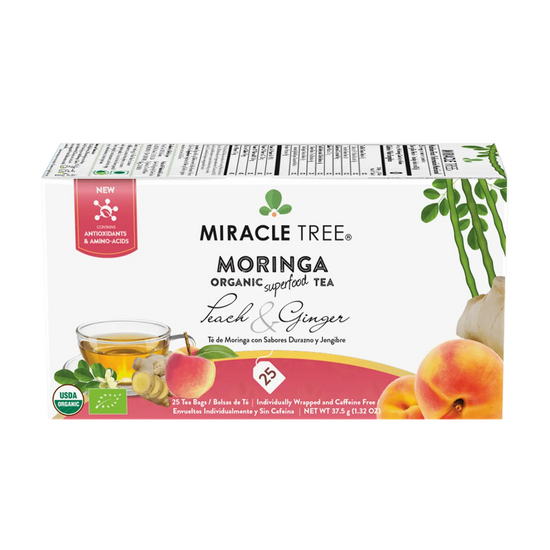
Save 10% on all Peach & Ginger Moringa Tea Purchases on orders $15+
DAILYOFFER
Short answer: moringa holds up well against kale, spirulina, matcha and wheatgrass on nutrient density, and it is the only one of the group that is a complete plant protein, caffeine-free, and drought-tolerant enough to grow without irrigation. It is not "better" at everything. Below is an honest comparison, including where the others win.
Most "moringa has 17x the calcium of milk" style claims - ours included - compare dried moringa leaf gram-for-gram against fresh food. That is a legitimate way to compare nutrient density, because drying removes water and concentrates everything else, but it is not the same as comparing what you would actually eat in a sitting. A teaspoon of moringa powder is a couple of grams; a glass of milk is over two hundred.
We think that is worth saying plainly. The nutrient density of moringa leaf is genuinely unusual, and it does not need inflating.
| Moringa | Kale | Spirulina | Matcha | Wheatgrass | |
|---|---|---|---|---|---|
| Complete protein (all 9 essential amino acids) | Yes | No | Yes | No | No |
| Caffeine | None | None | None | High | None |
| Plant-based iron | High | Moderate | High | Low | Moderate |
| Calcium | High | Moderate | Low | Low | Low |
| Can be drunk as a tea | Yes | No | No | Yes | No |
| Taste | Green, mildly earthy | Bitter, vegetal | Strong, marine | Grassy, umami, bitter | Sharp, very grassy |
We would rather be straight about this:
The sensible conclusion is not that one of these replaces the rest. It is that moringa is unusually versatile - a complete protein, caffeine-free, drinkable as a tea, and dense in iron and calcium - which is why it earns a place in a routine rather than a podium finish.
Both are the same leaf. Moringa tea is an infusion, so it delivers the water-soluble portion of the leaf in a pleasant hot drink. Moringa powder is the whole milled leaf, so it delivers considerably more per serving but has to be mixed into food. More on the difference, and on what the research does and does not show.
* These statements have not been evaluated by the Food and Drug Administration. This product is not intended to diagnose, treat, cure or prevent any disease.
See how moringa compares with popular superfoods, gram for gram
Gram for gram, dried moringa leaf compared with everyday foods. A typical serving is only a few grams, so per-serving amounts are much smaller.
more calcium than whole milk
more iron than raw spinach
more protein than plain yogurt
more potassium than bananas
caffeine — moringa is naturally caffeine-free


Bioavailability describes how well your body absorbs and uses a nutrient, and it depends on the whole food, not just the numbers on a label. Here is what moringa leaf brings to the table.
Our moringa is simply dried, milled leaf with nothing extracted or added, so you get the vitamins, minerals and plant compounds the leaf naturally contains, together.
Moringa leaf contains vitamin C alongside iron. Vitamin C helps the body absorb the non-heme iron found in plant foods. The leaf also provides calcium, magnesium and potassium.
Moringa has a mild, earthy taste that blends easily into tea, smoothies and everyday food, so it is simple to make part of a balanced routine.
Unlike matcha and other teas made from the tea plant, moringa leaf is naturally caffeine-free, so you can enjoy it at any time of day.
| Nutrient (per 100g) | Moringa Our Pick | Kale | Matcha | Spirulina | Wheatgrass |
|---|---|---|---|---|---|
| Protein | 27.1g | 2.9g | 29.6g | 57.5g | — |
| Calcium | 2,003mg | 254mg | 420mg | 120mg | — |
| Iron | 28.2mg | 1.6mg | 17.0mg | 28.5mg | — |
| Vitamin A | — | 241µg RAE | 2,400µg RAE | 29µg RAE | — |
| Vitamin C | 17.3mg | 93.4mg | 60mg | 10.1mg | — |
| Potassium | 1,324mg | 348mg | 2,700mg | 1,363mg | — |
| Antioxidants |
Values per 100 g of each food as sold: moringa leaf powder (Gopalakrishnan et al., Food Science and Human Wellness, 2016), matcha powder (MEXT Standard Tables of Food Composition in Japan, 8th ed.), spirulina (dried) and kale (fresh, raw) from USDA FoodData Central. Dried powders are concentrated, so a typical serving of a few grams provides far less. — = no reliable published figure. Vitamin A as µg RAE. Consult a healthcare professional before making dietary changes.
Both are nutrient-dense, and each has its strengths. Gram for gram, spirulina is higher in protein, while moringa leaf powder has far more calcium, with similar amounts of iron and potassium. Moringa also has a milder, earthy taste compared to Spirulina's strong oceanic flavor.
Matcha is a green tea and naturally contains caffeine. Moringa is naturally caffeine-free, so you can enjoy it any time of day. Many of our customers tell us a cup leaves them feeling refreshed and uplifted, and its leaves naturally provide B vitamins and iron.
Many people enjoy Moringa every day as part of a balanced diet. We recommend starting with 1-2 teaspoons of powder or 1-3 cups of tea per day and adjusting to what suits you. If you are pregnant, nursing, taking medication or have a medical condition, check with your healthcare provider first.
While Moringa leaves are generally considered safe and nutritious, we recommend consulting with your healthcare provider before adding any new supplement to your routine during pregnancy or while breastfeeding.
For Moringa powder, we recommend 1-2 teaspoons daily. For tea, 1-3 cups per day is ideal. Start with a smaller amount and gradually increase to find what works best for your body. Moringa is gentle and well-tolerated by most people.
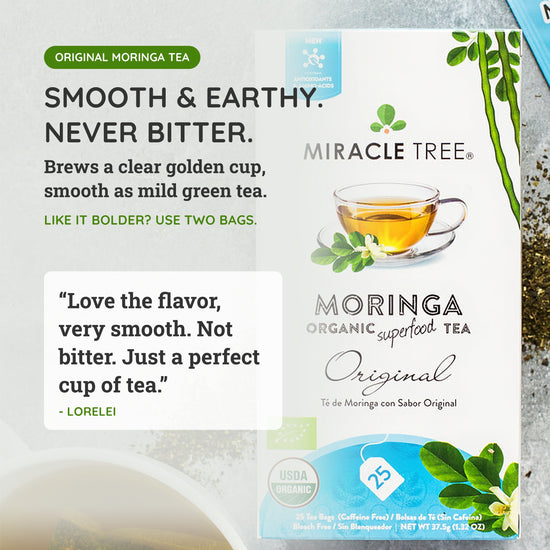
Moringa has a mild, earthy flavor with subtle green tea notes. Our premium Moringa tea blends are carefully crafted to be smooth and pleasant, making it easy to enjoy daily. Many customers describe it as refreshing and naturally sweet.
Yes, all Miracle Tree Moringa products are certified organic. We source our Moringa from sustainable farms in Sri Lanka that follow strict organic farming practices, ensuring the highest quality and purity.
We source our Moringa from certified organic farms in Sri Lanka, where the tropical climate is well suited to growing Moringa. Our single-origin approach supports traceability, quality and sustainable farming communities.
Shop with confidence knowing that our award-winning Miracle Tree products are loved by customers everywhere. Find your new favorites today.
Our moringa is certified organic under USDA and EU standards, grown in pristine Sri Lankan rainforests. That means higher nutrient density, true purity, and zero unnecessary additives. Every product we make is organic, Non-GMO, and held to the same uncompromising standard from leaf to cup.
We work directly with independent Sri Lankan farmers through a “bought-leaf” model, with up to 70% of value going back to them. This ensures better livelihoods, stronger partnerships, and consistent quality at origin. Ethical sourcing isn’t a claim—it’s how we operate every day.
Our teas are carefully cultivated and hand-processed by skilled artisans, not industrial systems. This preserves flavor, quality, and the natural benefits of moringa in every batch. The result is a cleaner, more refined cup—crafted with precision and care from start to finish.
Every ingredient is chosen for quality, nutrition, and purpose—nothing added without full visibility. Our direct supply chain gives us complete control from sourcing to final product. What goes in is intentional, traceable, and aligned with the standards behind every Miracle Tree product.