The honest answer for people tired of caffeine — and tired of being tired.
You've probably seen moringa described as a "natural energy booster." You've also probably been burned by that claim before — by adaptogens that did nothing, by herbal teas that tasted like lawn clippings, by supplements that delivered a placebo at best.
So let's be direct, and let's start by clearing up something that trips up a lot of people, including people who write about moringa.
Read this bit before anything else. "Moringa tea" is not one thing, and the caffeine answer is not one answer.
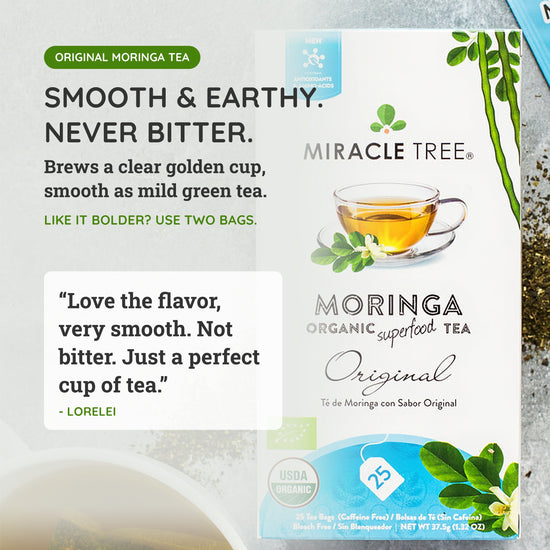
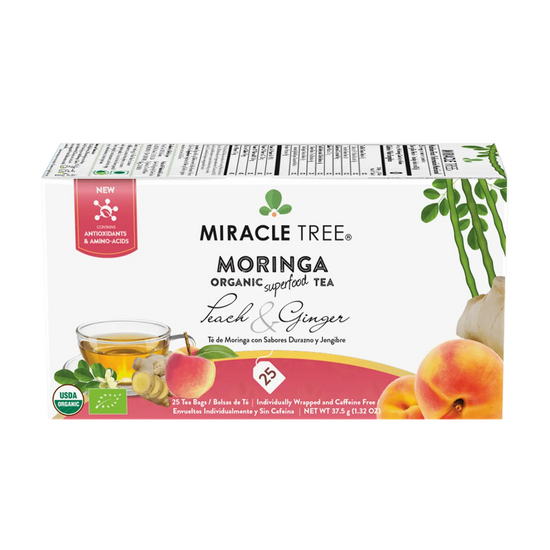
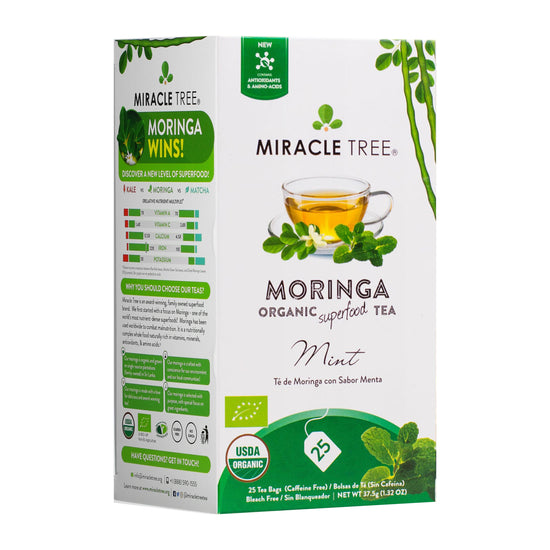
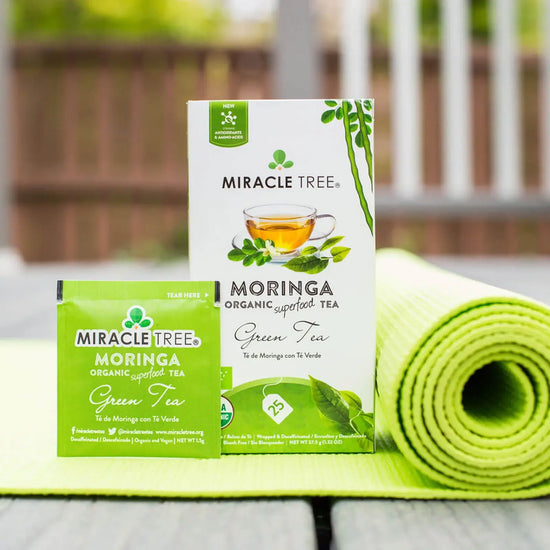
• Our herbal range is caffeine-free. Pure moringa leaf plus botanicals.
• Earl Grey and Green Tea are blended with real tea leaf, so they carry a trace.
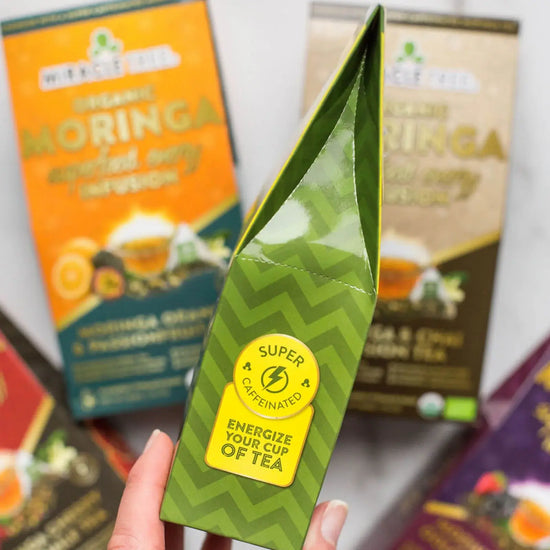
• Our Energy range is deliberately caffeinated — about 155mg per sachet, roughly a strong cup of coffee. It is sold as a coffee alternative. If you are avoiding caffeine, this is not the one to reach for.
Our caffeine guide gives the figure for every flavour we make.
So Does the Caffeine-Free Moringa Actually Do Anything for Energy?
Here is the honest framing. Pure moringa leaf is not a stimulant and will not do what coffee does. What it is, is a nutrient-dense food containing several nutrients that contribute to normal energy-yielding metabolism — iron, B vitamins and magnesium in particular.
That is a real mechanism, and it is also a slower and less dramatic one than caffeine. If you are well nourished already, adding a cup of tea is unlikely to transform your afternoons. If you have been running low on iron or magnesium — which is common — then improving that is worth more than another coffee.
What we are not going to tell you is that a teabag will fix your fatigue. Let's go through what each nutrient actually does.
The Nutrients That Matter Here
Iron — oxygen delivery
Iron is essential for haemoglobin, the protein in red blood cells that carries oxygen from your lungs to the rest of you. When iron is low, oxygen delivery to muscle and brain suffers, and the result is fatigue, brain fog and reduced physical and cognitive performance. Iron deficiency is the most common nutritional deficiency worldwide, and women of reproductive age, vegetarians, vegans and endurance athletes are disproportionately affected.
The link between iron status and physical work capacity has been reviewed in the literature. (Haas & Brownlie, Journal of Nutrition, 2001)
Gram for gram, dried moringa leaf powder contains about 10x the iron of spinach (per 100 g). Tea is more dilute than powder, so treat it as a contribution to your intake rather than a supplement dose.
B vitamins — the machinery
B vitamins contribute to normal energy-yielding metabolism, the process by which cells convert food into ATP. Moringa carries a useful spread:
-
B1 (Thiamine) — converts carbohydrate into usable energy; supports nerve function
-
B2 (Riboflavin) — involved in the electron transport chain
-
B3 (Niacin) — required for NAD+, a coenzyme central to energy metabolism
-
B6 (Pyridoxine) — amino acid metabolism and neurotransmitter synthesis
B vitamin status is associated with fatigue and cognitive performance. (Kennedy, Nutrients, 2016)
Magnesium
Magnesium is involved in hundreds of enzymatic reactions, including steps of ATP synthesis. A substantial share of adults consume less than the recommended amount, and the health consequences of that shortfall have been reviewed. (Rosanoff et al., Nutrition Reviews, 2012)
Moringa is a reasonable plant source. Again: a contribution, not a dose.
Antioxidant compounds
Moringa contains over 46 antioxidant compounds, including quercetin, kaempferol, chlorogenic acid, vitamin C and vitamin E. It scores well on laboratory antioxidant measures. (Vergara-Jimenez et al., Antioxidants, 2017) Those are test-tube measures, and what they mean for how you feel on a Tuesday afternoon is genuinely not established.
Caffeine vs. Nutrition: Two Different Things
| Factor |
Caffeine (coffee, or our Energy range) |
Caffeine-free moringa herbal tea |
| Mechanism |
Adenosine receptor blockade — a stimulant |
Nutritional — iron, B vitamins, magnesium |
| Onset |
20–45 minutes |
Nothing acute; nutrition accumulates |
| Sleep impact |
Can disrupt sleep if taken late |
None — drink it at 9pm |
| Dependency |
Yes, with withdrawal on stopping |
No |
| Best for |
Acute alertness when you need it |
A warm drink that adds nutrients and won't keep you up |
The point: these are not competitors. If you want alertness in the next half hour, you want caffeine — and our Energy range is a legitimate way to get it, at about 155mg a sachet, if you would rather have tea than coffee. If you want something to drink in the evening that isn't empty, the caffeine-free herbal range is the one.
What the Evidence Actually Supports
Solid: the nutrient composition of moringa leaf, and the established roles of iron, B vitamins and magnesium in normal energy-yielding metabolism. That is textbook nutrition, and the citations above are real papers you can go and read.
Not solid: claims that moringa itself reduces fatigue. You will find pages citing trials in Phytotherapy Research or Journal of Food Science and Technology for this. Check whether those citations actually link to a study. Human trials on moringa and fatigue specifically are few, small and short, and we are not going to lean on them.
The honest position on moringa generally is that there is not enough good human evidence to say it helps with any specific health condition. We sell the stuff and we would rather you heard that from us.
Who This Is Most Likely to Matter For
People low in iron: women of reproductive age, vegetarians, vegans, endurance athletes, frequent blood donors. If you are low, improving iron status matters, and a daily nutrient-dense drink is a reasonable contributor alongside the rest of your diet.
People low in magnesium: chronic stress, heavy alcohol use and intense exercise all deplete it.
People cutting down on caffeine: the honest value here is having something to drink. A ritual survives a habit change better than willpower does.
And an important caveat: if your fatigue is persistent and unexplained, that is a medical question. Thyroid dysfunction, sleep apnoea, clinical anaemia and depression all present as tiredness, and none of them are addressed by tea. Get it looked at.
Getting the Most From It
Add lemon. Vitamin C meaningfully improves absorption of plant-source iron, and this is the single most useful thing on this page. A squeeze of lemon in your moringa tea is doing real work.
Mind the timing around iron. Calcium-rich foods, and coffee or black tea, inhibit non-haem iron absorption. Leaving an hour between them helps.
Brew it properly. Steep 3–5 minutes in water just off the boil, covered. Under-steeping is the most common mistake — see the brewing guide.
Be consistent. Nutrition is cumulative. One cup is not an event.
Recipes
Morning Tea with Lemon
- 1 Miracle Tree herbal moringa tea bag
- 8 oz water just off the boil, steep 3–5 minutes, covered
- Juice of ½ lemon (helps iron absorption)
- 1 tsp raw honey
- Optional: pinch of cinnamon
Pre-Workout Moringa Smoothie
- 1 cup coconut water
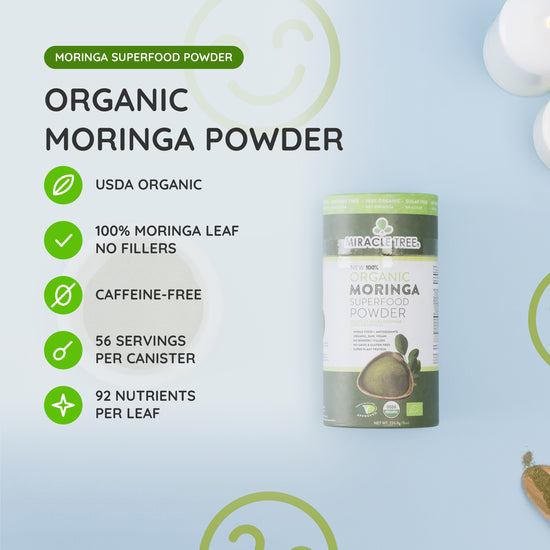
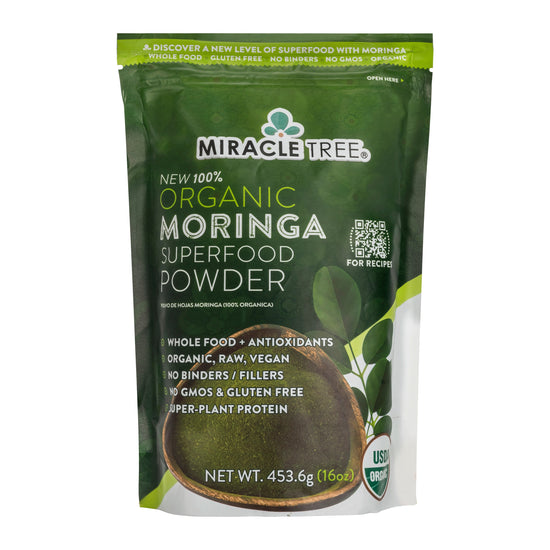
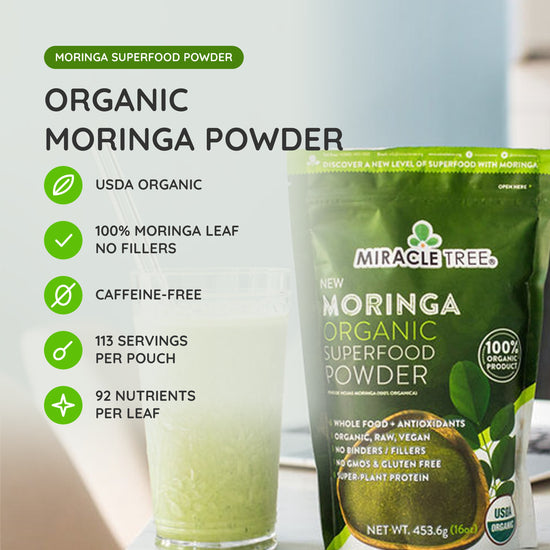
- 1 tsp Miracle Tree Moringa Powder (pre-dissolved)
- 1 frozen banana, ½ cup frozen mango
- 1 tbsp chia seeds, juice of ½ lime
- Small handful of spinach
Afternoon, If You Want the Caffeine
Common Myths
Myth: "Moringa gives you an instant lift like coffee."
Fact: Caffeine-free moringa is not a stimulant and there is nothing acute to feel. If you want the coffee-like effect from us, that is what the Energy range is for, and it works because of the caffeine in it.
Myth: "All moringa tea is caffeine-free."
Fact: The herbal range is. Earl Grey and Green Tea carry a trace. The Energy range is deliberately caffeinated at roughly a strong coffee per sachet. Check the caffeine guide.
Myth: "If I don't feel it immediately, it isn't working."
Fact: True of any food. You don't feel spinach either.
Myth: "More is better."
Fact: One to two cups a day is sensible. More doesn't buy you anything and may upset your stomach.
FAQ
Q: Does moringa tea have caffeine?
A: It depends which one. Our herbal range is caffeine-free. Earl Grey and Green Tea contain a trace because they are blended with real tea leaf. Our Energy range contains about 155mg per sachet, roughly a strong coffee. The caffeine guide lists every flavour.
Q: Can I drink moringa tea instead of coffee?
A: If you want the caffeine, our Energy range is the direct swap. If you are trying to get off caffeine, the caffeine-free herbal range gives you the ritual without the stimulant — but be honest with yourself that the first week will feel different.
Q: Which one can I drink in the evening?
A: The caffeine-free herbal range. Not the Energy range — that one will keep you up.
Q: How does caffeine-free moringa relate to energy at all, then?
A: Through nutrition rather than stimulation. Iron supports oxygen transport, B vitamins and magnesium contribute to normal energy-yielding metabolism. If you were low in those, improving them matters. If you weren't, expect less.
Q: Can moringa help with chronic fatigue?
A: No, and please don't use it that way. Persistent or unexplained fatigue needs a doctor, not a tea.
Summary
-
Caffeine-free herbal moringa contributes iron, B vitamins and magnesium — nutrients that contribute to normal energy-yielding metabolism. Cumulative, unspectacular, real.
-
The Energy range contains about 155mg of caffeine per sachet and works the way any caffeinated drink works. Not for the evening.
-
Neither is a treatment for fatigue. If tiredness is persistent or unexplained, see a doctor.
- The most useful trick on this page is a squeeze of lemon, for iron absorption.
Browse the caffeine-free herbal range →
Browse the Energy range (caffeinated) →
Caffeine content of every flavour →
What happens when you drink moringa tea every day →
These statements have not been evaluated by the Food and Drug Administration. This product is not intended to diagnose, treat, cure, or prevent any disease.