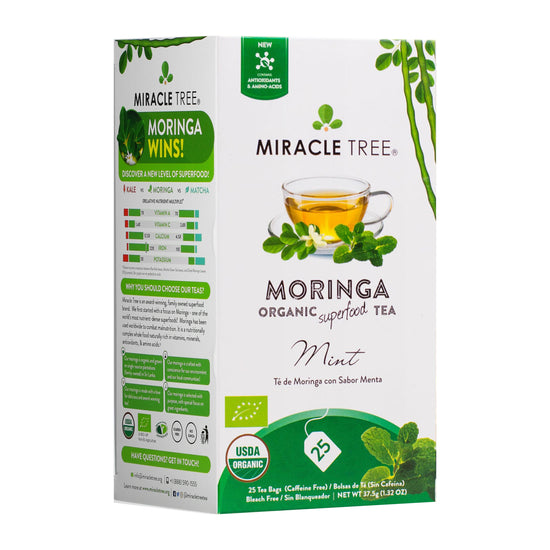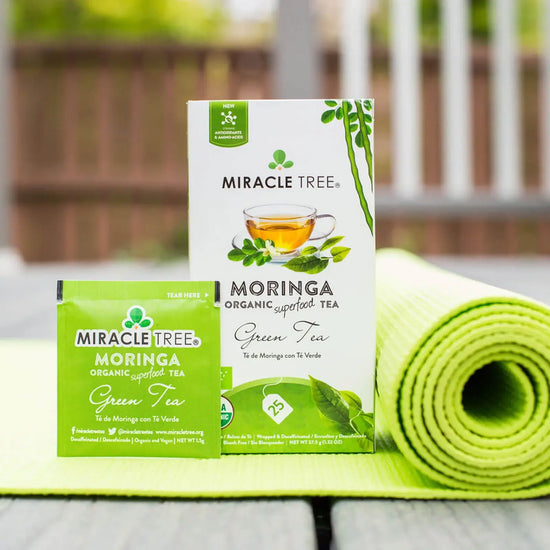





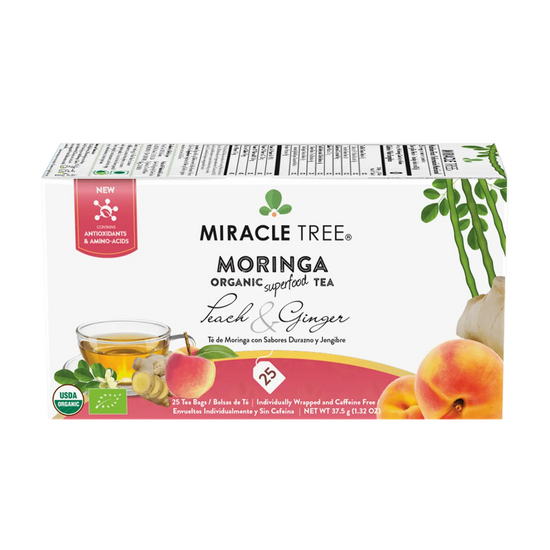
Save 10% on all Peach & Ginger Moringa Tea Purchases on orders $15+
DAILYOFFER
What does research say about moringa? Moringa oleifera leaf is well documented as a nutrient-dense food: lab analyses consistently find protein, minerals, vitamins and plant polyphenols. Research on what moringa does in the body is much earlier. Most of it comes from lab and animal studies, and the few human studies so far are small and short.
This page walks through what has been studied, how strong each line of evidence is, and why a cup of tea is not the same thing as the amounts used in research. Every study we mention is linked in the References at the end.
Key takeaways
- Nutrients: well documented. Dried moringa leaf contains protein with all nine essential amino acids, plus calcium, iron, potassium, magnesium, and vitamins A, C and E.
- Antioxidant compounds: measured in the leaf. Quercetin and kaempferol are among the main polyphenols. One small human study tracked blood antioxidant markers.
- Effects in people: not settled. A handful of small, short human studies exist, and no conclusion can be drawn from them yet.
- Most findings are from animals or lab tests, often using concentrated extracts, not leaf at food amounts.
- Tea, powder and extracts differ. A tea bag holds about 1.5 grams of leaf. The human study described below used 7 grams of leaf powder a day.
- Ask your doctor first if you are pregnant, breastfeeding or take medication.
Moringa oleifera is a fast-growing tree native to the Indian subcontinent. Its leaves are traditionally eaten as a vegetable in South Asia and other tropical regions. Researchers also study its seeds, pods, roots and bark, so it matters which part a study used.
Miracle Tree uses the leaf only. It is grown organically in Sri Lanka and solar-dried. Our moringa teas and powder use dried leaf, not a concentrated extract.
This is the part of moringa research that is not seriously disputed. Leaf samples have been analyzed many times, and they reliably contain protein, minerals and beta-carotene. A 2015 analysis of leaves grown in Chad, Sahrawi refugee camps and Haiti found all three samples rich in these nutrients, but also found real differences between them. Soil, climate and drying change the numbers.
Here is what one serving of our powder provides, from its Nutrition Facts label:
| Per serving: 2 teaspoons (4 g) | Amount |
|---|---|
| Calories | 7 |
| Protein | 1 g |
| Fiber | 1 g |
| Iron | 10% Daily Value |
| Calcium | 10% Daily Value |
| Vitamin A | 6% Daily Value |
| Vitamin C | 6% Daily Value |
| Thiamin (vitamin B1) | 6% Daily Value |
The leaf also contains vitamins B2, B3, B6, B7, D, E and K, potassium, magnesium, and plant pigments such as lutein, zeaxanthin and chlorophyll.
That is a useful contribution to a meal, not a multivitamin. What those nutrients do is established nutrition science, not moringa-specific research. Iron is part of hemoglobin, which carries oxygen in the blood.* Calcium and vitamin K are used in normal bone maintenance.* Your body uses essential amino acids to build and repair tissue.* For more detail, see how many amino acids are in moringa and a breakdown of moringa's nutrition.
Moringa leaf contains several families of plant compounds that researchers group as antioxidants. The 2015 leaf analysis found quercetin and kaempferol compounds were the main polyphenols. A 2015 review in Phytotherapy Research also lists phenolic acids, flavonoids and glucosinolates, and notes that leaf extracts showed the greatest antioxidant activity of the plant parts reviewed.
Vitamins C and E, both present in the leaf, are antioxidant nutrients that help protect cells from oxidative stress.*
A test-tube result does not tell you what happens in a person, so human data is the key question. The clearest example is a 2014 study in India. It followed 90 postmenopausal women for three months. One group of 30 added 7 grams of moringa leaf powder to their daily diet, and another group of 30 made no change. In the moringa group, blood levels of vitamin A, vitamin C and two antioxidant enzymes went up, and a marker of oxidative stress went down.
The limits are important. There was no placebo and no blinding. Each group had only 30 women. And 7 grams a day is almost two powder servings. It measured blood markers, not health outcomes.
Beyond nutrients and antioxidant compounds, a small number of short human studies have looked at markers of metabolic health. Their results are mixed and early. The studies were small, and they used different doses, forms and designs.
No conclusion can be drawn from them yet. This page makes no claim that moringa affects any health condition.
Much of what gets repeated about moringa online traces back to lab or animal work. That research is useful for generating ideas, but it answers a different question than a human study does:
A 2015 overview in the International Journal of Molecular Sciences put it directly: many cell and animal studies agree with each other, but there are still too few human studies to recommend moringa leaves as medication. That is still a fair summary today.
| Topic | Human studies | Animal studies | Lab studies | Where it stands |
|---|---|---|---|---|
| Nutrient content | Not needed | Not needed | Many analyses | Well documented; varies by growing region |
| Antioxidant markers | One 3-month study, no placebo | Yes | Many | Compounds confirmed; human effects early |
| Thyroid hormones | None found | One rat study | - | Unknown in people; a reason for caution |
| Medication interactions | None found | - | One enzyme study | Unknown in people; a reason for caution |
When you read that "moringa did X in a study," the first question to ask is: which moringa, and how much?
| Form | Typical amount | What you get |
|---|---|---|
| Brewed tea | About 1.4 to 1.5 g of leaf per bag | Only what dissolves into hot water; the leaf stays in the bag |
| Leaf powder | 4 g (2 teaspoons) per serving | The whole leaf, including fiber and protein |
| Human study on this page | 7 g a day in the diet | Leaf powder, almost two food servings |
| Extracts in animal studies | Measured per kg of body weight | Concentrated compounds, often far above food amounts |
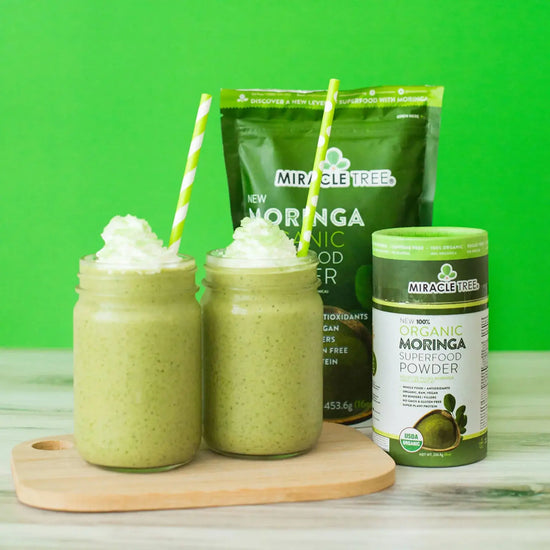
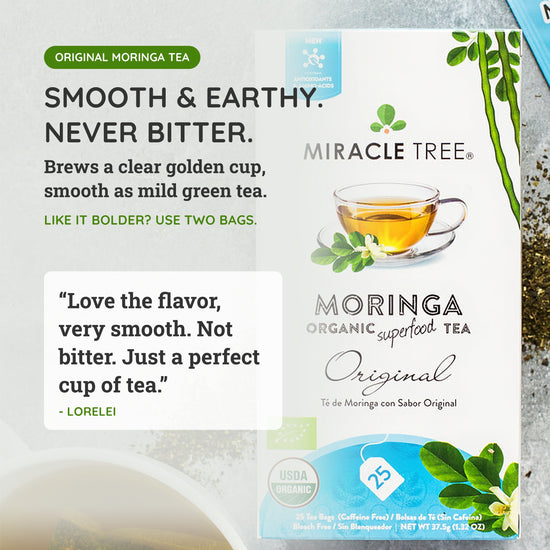
So a result from 7 grams of powder a day, or from a concentrated rat extract, tells you very little about a cup of tea. We sell moringa as a food: Original Moringa Tea for a mild, grassy cup, and Organic Moringa Powder to stir into smoothies, yogurt or soup.
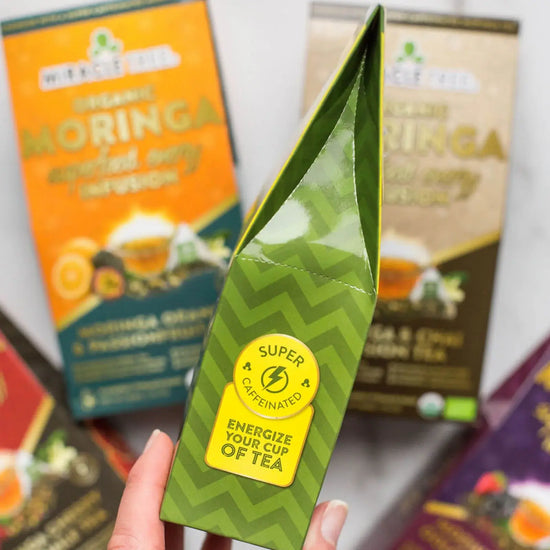
On caffeine, moringa leaf is naturally caffeine-free, and so are most of our herbal teas. There are exceptions: our Green Tea blend is decaffeinated (under 1 mg per cup), Earl Grey is lightly caffeinated (5 to 10 mg per cup), and the Energy tea line has caffeine added. See does moringa tea have caffeine?
A 2015 review in Phytotherapy Research found no side effects reported in the human studies it covered. Those studies were short. That is helpful short-term information, but it is not long-term safety data.
Animal and lab studies add some caution flags:
We do not know enough to say how moringa affects these situations, so the right answer comes from someone who knows your health. Our article can pregnant women take moringa? explains why.
Research confirms that moringa leaf is rich in nutrients such as protein, calcium, iron and vitamins A and C, and contains polyphenols like quercetin. Studies on its effects in the body are mostly lab and animal work. The few human studies are small and short, and no firm conclusions can be drawn from them.
There is good evidence for its nutrient content. For effects in people, the evidence is early. Only a handful of small, short human studies exist, and reviews call for more human research.
They are not directly comparable. A tea bag holds about 1.5 grams of leaf, and you drink only what infuses into the water. The human study described on this page used 7 grams of whole leaf powder a day. No study we cite tested brewed moringa tea.
The human study described on this page used 7 grams of leaf powder a day in the diet, for three months. That is almost two powder servings of 4 grams each, and several times the leaf in one tea bag.
Moringa leaf is traditionally eaten as a vegetable, and a 2015 review found no side effects reported in the short human studies it covered. Long-term studies are lacking. If you are pregnant, breastfeeding, take medication or have a health condition, ask your doctor before making it a daily habit.
It has not been properly studied in people. A lab study found leaf extracts slowed a liver enzyme that processes many medications, and a rat study found changes in thyroid hormones. If you take any prescription medication, talk to your doctor or pharmacist first.
The moringa leaf is naturally caffeine-free. Some blends are not: our Green Tea blend is decaffeinated with under 1 mg per cup, Earl Grey is lightly caffeinated with 5 to 10 mg per cup, and our Energy teas contain added caffeine.
Each study is listed by author, journal and year, with a note on what kind of study it is. Links go to the PubMed record or the publisher via DOI.
Research is cited for information only. Studies describe what was found under specific conditions and do not describe the effects of any Miracle Tree product.
*These statements have not been evaluated by the Food and Drug Administration. These products are not intended to diagnose, treat, cure, or prevent any disease.
Shop with confidence knowing that our award-winning Miracle Tree products are loved by customers everywhere. Find your new favorites today.
Our moringa is certified organic under USDA and EU standards, grown in pristine Sri Lankan rainforests. That means higher nutrient density, true purity, and zero unnecessary additives. Every product we make is organic, Non-GMO, and held to the same uncompromising standard from leaf to cup.
We work directly with independent Sri Lankan farmers through a “bought-leaf” model, with up to 70% of value going back to them. This ensures better livelihoods, stronger partnerships, and consistent quality at origin. Ethical sourcing isn’t a claim—it’s how we operate every day.
Our teas are carefully cultivated and hand-processed by skilled artisans, not industrial systems. This preserves flavor, quality, and the natural benefits of moringa in every batch. The result is a cleaner, more refined cup—crafted with precision and care from start to finish.
Every ingredient is chosen for quality, nutrition, and purpose—nothing added without full visibility. Our direct supply chain gives us complete control from sourcing to final product. What goes in is intentional, traceable, and aligned with the standards behind every Miracle Tree product.