




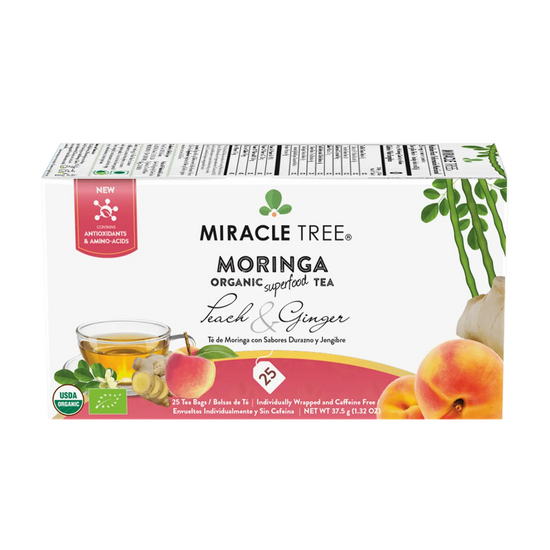
Économisez 10 % sur tous les achats de thé Moringa Pêche et Gingembre pour les commandes de 15 $ et plus
DAILYOFFER
Réponse courte : le thé au moringa est une infusion préparée à partir des feuilles séchées de Moringa oleifera, un arbre originaire d'Asie du Sud. Ce n'est pas un vrai thé - il ne contient pas de Camellia sinensis -, et c'est pourquoi la feuille de moringa pure est naturellement sans caféine. Son goût est végétal et légèrement terreux, plus proche d'un thé vert léger que d'une infusion de fruits, et il offre une densité nutritionnelle vraiment inhabituelle pour une boisson chaude.
Cultiver, sécher et assembler le moringa, c'est notre métier. Cette page s'en tient donc à ce que nous pouvons réellement mesurer : ce que contient la feuille, combien de caféine il y a dans la tasse, quel goût cela a, comment l'infuser et - honnêtement - ce que la recherche publiée permet d'affirmer ou non.
Le thé au moringa s'obtient en faisant infuser des feuilles séchées de Moringa oleifera dans de l'eau chaude. L'arbre de moringa pousse en Asie du Sud et en Afrique subsaharienne et sert de plante alimentaire depuis des siècles. Ce sont ses feuilles que l'on utilise pour l'infusion.
Deux conséquences en découlent, et elles expliquent l'essentiel de ce qui surprend les gens :
Feuille de moringa pure : aucune. Ce qui change, c'est de savoir si un produit donné est du moringa pur ou un mélange. Dans notre gamme, 18 des 20 parfums aux plantes sont totalement sans caféine, et les deux exceptions sont des mélanges :
| Thé | Caféine par tasse |
|---|---|
| 18 parfums de moringa aux plantes (Original, Mint, Lemon, Mango et d'autres) | 0 mg |
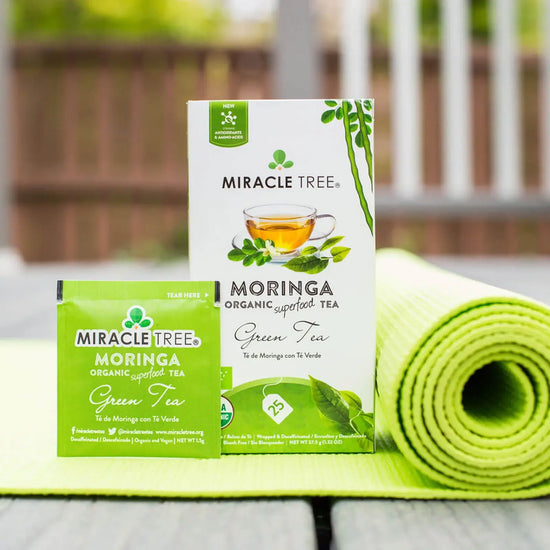
| Green Tea Moringa (assemblé avec du thé vert décaféiné) | moins de 1 mg |
| Earl Grey Moringa (un assemblage léger au thé noir) | 5-10 mg |
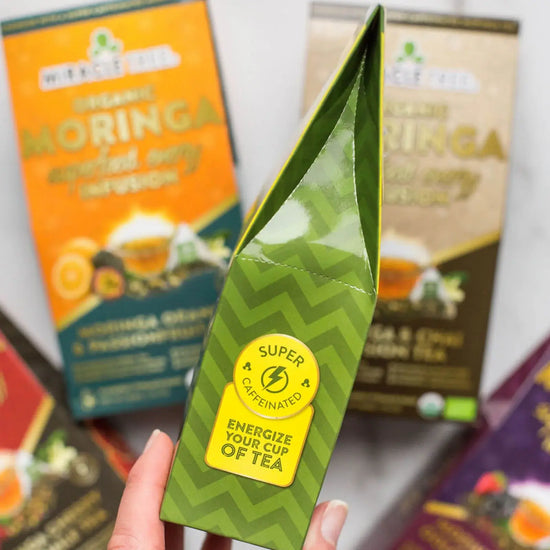
| Moringa Energy Tea (caféiné volontairement) | 155 mg |
| À titre de comparaison : café filtre | ~95 mg |
Cette dernière ligne compte. Certains produits au moringa sont conçus comme des alternatives au café et sont fortement caféinés : le nôtre contient 155 mg par sachet, plus qu'une tasse de café. Si vous buvez du thé au moringa précisément pour éviter la caféine, vérifiez le produit lui-même plutôt que de supposer que « moringa » veut dire « sans caféine ». Voir le détail complet de la caféine pour chacun de nos thés.
Végétal, herbacé et légèrement terreux, avec une finale nette et une fine douceur naturelle. Si vous aimez les thés verts légers, vous reconnaîtrez la famille tout de suite. Si vous attendez une infusion de fruits, le moringa nature vous paraîtra plus végétal que prévu.
Il n'est pas amer lorsqu'il est bien infusé, mais une infusion trop longue dans une eau à gros bouillons accentue la note verte. Assembler le moringa avec des fruits, des épices ou des fleurs adoucit nettement le côté terreux : c'est pourquoi la plupart des thés au moringa parfumés n'ont rien à voir avec la feuille nature.
Disons-le franchement : une minorité constante de nos propres dégustateurs n'apprécie pas la note terreuse du moringa non parfumé. C'est bon à savoir avant d'acheter une première boîte. Lire des notes de dégustation honnêtes sur les 20 parfums.
Le moringa pardonne davantage que le thé vert, mais il récompense une température bien choisie.
Couvrez la tasse pendant l'infusion si vous le pouvez. L'essentiel des arômes part avec la vapeur.
La feuille de moringa est exceptionnellement dense en nutriments pour une feuille que l'on peut infuser. Une tasse de thé au moringa contient :
Une réserve honnête que la plupart des pages passent sous silence : une infusion n'équivaut pas à manger la feuille. L'eau n'extrait que la partie hydrosoluble de ce que contient la feuille, pas la totalité. Si vous voulez le profil nutritionnel complet du moringa, la poudre de moringa - où vous consommez la feuille entière - en apporte nettement plus par portion qu'une tasse infusée. Nous vendons les deux, et nous préférons que vous connaissiez la différence.
C'est là que la plupart des pages sur le moringa en font trop ; voici donc notre position, aussi clairement que possible.
Le moringa a été beaucoup étudié, mais la très grande majorité de ces travaux relèvent de la recherche en laboratoire et sur l'animal. Des essais cliniques chez l'humain existent, mais ils sont bien plus rares, généralement de petite taille, souvent courts, et fréquemment menés sur de la poudre ou de l'extrait de feuille de moringa à des doses très supérieures à ce qu'apporte une tasse d'infusion. Des résultats prometteurs en laboratoire échouent régulièrement à se reproduire chez l'humain, et une étude sur un extrait concentré ne dit presque rien d'un sachet d'infusion.
Ce que l'on peut dire avec justesse est plus étroit et moins spectaculaire : la feuille de moringa est un aliment dense en nutriments, elle apporte des vitamines, des minéraux, des acides aminés et des composés antioxydants à l'alimentation, et elle est largement consommée comme plante alimentaire, avec une longue histoire d'usage alimentaire ordinaire.
Ce que l'on ne peut pas dire sérieusement, c'est que le thé au moringa traite, prévient ou améliore une quelconque affection médicale. Si vous voyez un produit au moringa présenté ainsi, l'affirmation devance les preuves - et, aux États-Unis, devance aussi ce qu'une entreprise alimentaire a le droit de dire. Nous vendons du thé. Nous n'irons pas vous dire que c'est un médicament.
La feuille de moringa est généralement bien tolérée en tant qu'aliment. Quelques précautions de bon sens :
Tous les thés au moringa ne se valent pas. Quatre points à vérifier, quelle que soit la marque :
Le thé au moringa est-il la même chose que le thé vert ?
Non. Le thé vert vient de Camellia sinensis ; le moringa vient d'un arbre totalement différent. Leurs goûts se ressemblent assez pour qu'on les confonde, mais le thé vert contient de la caféine et le moringa pur n'en contient pas.
Puis-je boire du thé au moringa tous les jours ?
Oui : c'est un aliment, et un usage quotidien n'a rien d'inhabituel. Les précautions ci-dessus s'appliquent si vous êtes enceinte, allaitante ou sous traitement prescrit.
Puis-je en boire le soir ?
Les parfums de moringa sans caféine, oui. Vérifiez d'abord le produit précis, car les thés au moringa de type énergisant sont très caféinés.
Le thé au moringa vaut-il mieux que la poudre de moringa ?
Il est différent, pas meilleur. L'infusion vous apporte la fraction hydrosoluble dans une boisson chaude agréable. La poudre vous apporte la feuille entière et nettement plus par portion, mais elle doit être mélangée à un plat ou à un smoothie.
Le thé au moringa est-il amer ?
Il ne devrait pas l'être. L'amertume signifie généralement que l'eau était trop chaude ou l'infusion trop longue - ou que la feuille était de qualité médiocre ou trop ancienne.
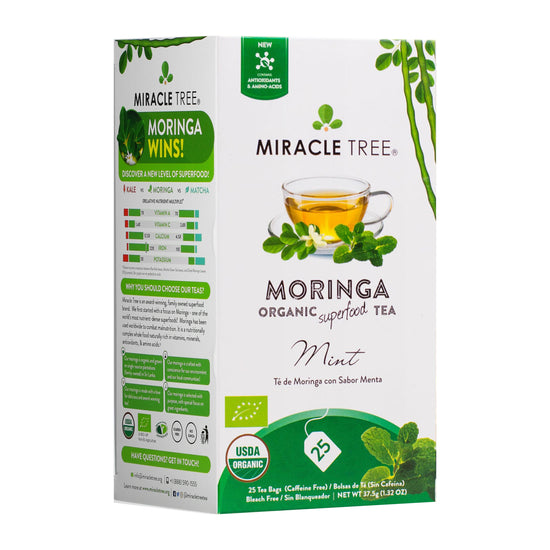
Si vous découvrez le moringa, le conseil honnête est de commencer par un parfum plutôt que par la feuille nature - Lemon, Apple & Cinnamon ou Mint sont les entrées en matière les plus douces - puis d'essayer Original une fois que vous savez que la base vous plaît.
Acheter le thé au moringa sans caféine, 20 parfums | Acheter le thé énergisant au moringa caféiné | Acheter la poudre de moringa
* Ces déclarations n'ont pas été évaluées par la Food and Drug Administration. Ce produit n'est pas destiné à diagnostiquer, traiter, guérir ni prévenir une quelconque maladie.
Achetez en toute confiance, sachant que nos produits primés Miracle Tree sont appréciés par les clients du monde entier. Trouvez vos nouveaux produits préférés dès aujourd'hui.
Notre moringa est certifié biologique selon les normes USDA et UE, et cultivé dans les forêts tropicales préservées du Sri Lanka. Cela signifie une densité nutritionnelle plus élevée, une véritable pureté et aucun additif superflu. Chacun de nos produits est biologique, sans OGM et soumis à la même exigence sans compromis, de la feuille à la tasse.
Nous travaillons directement avec des agriculteurs indépendants du Sri Lanka selon un modèle d’« achat de feuilles », où jusqu’à 70 % de la valeur leur revient. Cela garantit de meilleurs moyens de subsistance, des partenariats plus solides et une qualité constante à l’origine. L’approvisionnement éthique n’est pas un argument — c’est notre façon de travailler au quotidien.
Nos thés sont cultivés avec soin et transformés à la main par des artisans expérimentés, et non par des systèmes industriels. Cela préserve la saveur, la qualité et les bienfaits naturels du moringa dans chaque lot. Le résultat : une tasse plus pure et plus raffinée, élaborée avec précision et soin du début à la fin.
Chaque ingrédient est choisi pour sa qualité, sa valeur nutritionnelle et sa raison d’être — rien n’est ajouté sans une totale transparence. Notre chaîne d’approvisionnement directe nous donne un contrôle complet, de l’approvisionnement au produit final. Ce qui entre dans nos produits est intentionnel, traçable et conforme aux exigences qui sous-tendent chaque produit Miracle Tree.